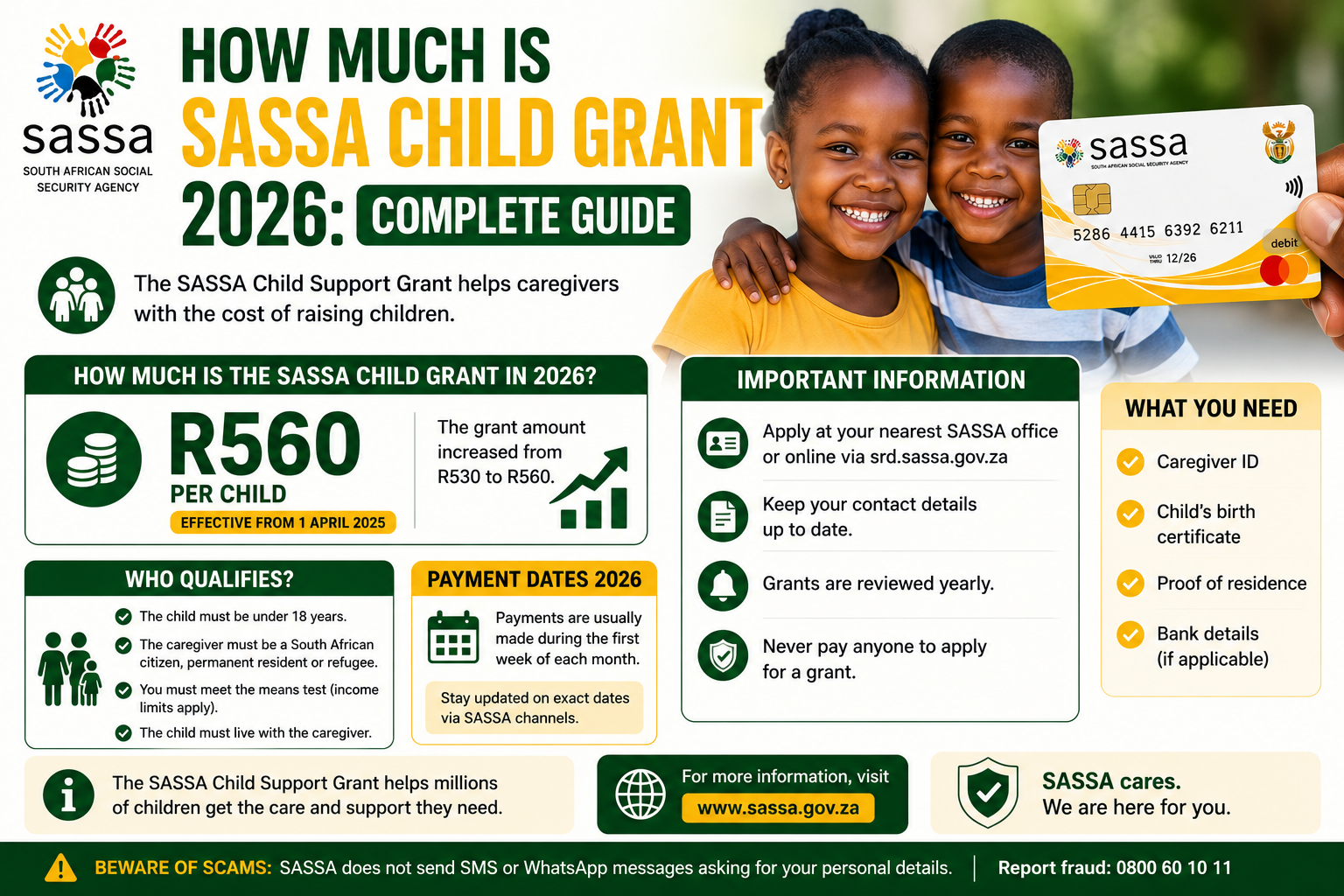
Learn the 2026 SASSA Child Support Grant amount, eligibility rules, payment dates, and how to apply. Get the latest official grant updates in one guide.
Understanding SASSA Child Grants in South Africa
The South African Social Security Agency (SASSA) provides crucial financial support to millions of families across South Africa through various child grant programs. If you’re a caregiver or guardian looking to understand how much financial assistance you can receive for the children in your care, this guide will help you navigate the different child grants available in 2026.
What Is SASSA Child Grant?
SASSA child grants are monthly financial payments provided by the South African government to help caregivers support children who are vulnerable, orphaned, or have special needs. These grants aim to reduce child poverty and ensure that children have access to basic necessities such as food, education, and healthcare.
The South African Social Security Agency administers these grants to more than 13 million qualifying households with children under the age of 18. Understanding which grant you qualify for and how much you’ll receive is essential for proper family financial planning.
SASSA Child Grant Amounts for 2026
Child Support Grant
Amount: R580 per month
The Child Support Grant is the most widely distributed children’s grant in South Africa, supporting over 13 million households. This grant increased from R560 to R580 in April 2026, an increase of R20 per month.
The Child Support Grant is designed for caregivers looking after children under the age of 18. It doesn’t matter whether you are the biological parent, grandparent, or another family member caring for the child. You just need to meet the eligibility criteria and pass the means test.
Foster Child Grant
Amount: R1,290 per month
The Foster Child Grant is specifically for court-appointed guardians caring for foster children. This grant increased from R1,250 to R1,290 in April 2026, representing an increase of R40 per month.
This grant provides higher monthly support than the Child Support Grant because foster care typically involves formal legal arrangements and additional responsibilities. To qualify for this grant, you must have obtained legal custody of the child through the courts.
Care Dependency Grant
Amount: R2,400 per month
The Care Dependency Grant is the highest-paying child-related grant, with a monthly amount of R2,400 as of April 2026. This represents an increase of R80 from the previous amount of R2,320.
This grant is designed for children under 18 years old who have severe physical or mental disabilities. The child must be assessed and declared disabled by a state-appointed doctor before you can qualify for this grant. This higher amount reflects the additional costs associated with caring for a child with significant medical or developmental needs.
Who Qualifies for SASSA Child Grants?
General Eligibility Requirements
To qualify for any SASSA child grant, you must meet certain basic requirements:
- Be a South African citizen, permanent resident, or refugee living in South Africa
- Be the primary caregiver of a child under 18 years old
- Pass a means test (income and asset limits apply)
- Provide valid identification and supporting documents
- Have a valid bank account or access to payment methods
Means Test Requirements
SASSA uses a means test to determine your eligibility based on your income and assets. The means test ensures that grants reach families who genuinely need financial support.
For child grants, your monthly income (and your spouse’s if married) must fall below a certain threshold. The exact income limits vary depending on the type of grant you’re applying for, but they’re designed to support low-income families.
Child Support Grant Specifics
To qualify for the Child Support Grant, you need:
- The child’s birth certificate
- Your identification document
- Proof of your relationship to the child
- Income documentation (payslips, IRP5, or proof of unemployment)
Foster Child Grant Specifics
For the Foster Child Grant, additional requirements include:
- A certified court order confirming the foster care arrangement
- The child’s birth certificate
- Your identification document
Care Dependency Grant Specifics
For the Care Dependency Grant, you’ll need:
- A medical report from a state-appointed doctor confirming the child’s disability
- The child’s birth certificate
- Your identification document
- Proof of the child’s disability assessment
How Much Will You Receive in 2026?
Payment Frequency
All SASSA child grants are paid monthly. Payments are typically made on the first Thursday of each month, though dates may occasionally shift due to holidays or administrative reasons.
If you’re caring for multiple children, you can receive the grant for each eligible child. For example, if you have two children under 18 qualifying for the Child Support Grant, you would receive R580 for each child, totaling R1,160 per month.
Payment Methods
SASSA offers several payment options:
- Direct bank transfer to your personal bank account
- Payment at participating banks
- Payment through SASSA payment sites
- Collection through retailers in partnership with SASSA
Recent Increases to Child Grants
2026 Increase Details
The South African government announced grant increases effective from April 2026. These increases were aligned with the inflation rate to ensure that grants keep pace with the rising cost of living.
The 3.4% increase to child grants means:
- Child Support Grant and Grant-in-Aid: +R20 increase to R580
- Foster Child Grant: +R40 increase to R1,290
- Care Dependency Grant: +R80 increase to R2,400
Why Were Increases Limited?
The National Treasury ties annual SASSA grant increases to South Africa’s inflation rate. In 2025, inflation stayed within the 3.2% to 3.5% range, which is why 2026 saw a 3.4% increase. This approach ensures that grant amounts grow at a pace that matches the actual rise in living costs.
How to Apply for SASSA Child Grants
Steps to Apply
- Gather Your Documents: Collect all required documents including your ID, the child’s birth certificate, proof of income, and any medical reports if applicable.
- Visit a SASSA Office: Go to your nearest SASSA office in person. You’ll need to complete the application form for the specific grant you’re applying for.
- Submit Your Application: Hand in your completed form along with all supporting documents to the SASSA official.
- Follow Up: Keep track of your application status. SASSA typically processes applications within 2-3 months.
- Receive Approval: Once approved, you’ll be notified about your payment date and how you’ll receive your grant funds.
What Documents to Bring
- Your South African Identity Document (ID)
- Child’s birth certificate
- Proof of relationship to the child
- Proof of income (payslips, IRP5, or unemployment letter)
- Valid bank account details for payment
- Court order (for Foster Child Grant)
- Medical report (for Care Dependency Grant)
Payment Dates for 2026
SASSA maintains a strict payment schedule to ensure beneficiaries receive their grants on time. Child grants are typically paid on the first Thursday of each month. However, it’s advisable to check with your local SASSA office for any holiday adjustments or special circumstances.
Challenges and Important Information
Income Limits
While receiving a SASSA grant, there are income limits you must not exceed. If your income increases beyond the specified threshold, your grant may be stopped or reduced. It’s important to report any changes in your financial circumstances to SASSA.
Means Testing Reviews
SASSA regularly reviews beneficiaries’ circumstances to ensure grants are reaching those who truly need them. If selected for a review, you’ll need to provide updated proof of income and other relevant documents.
Payment Delays
Occasionally, SASSA may experience delays in payment processing due to administrative issues or system problems. If you don’t receive your grant on the expected date, contact your nearest SASSA office for assistance.
Conclusion
SASSA child grants play a vital role in supporting South African families in 2026. Whether you qualify for the Child Support Grant (R580), Foster Child Grant (R1,290), or Care Dependency Grant (R2,400), these monthly payments provide crucial financial assistance for children’s wellbeing.
If you believe you qualify for any of these grants, contact your nearest SASSA office to start the application process. Ensure you have all required documents ready to streamline the process. These grants are designed specifically to help families like yours provide better care and support for children in your charge.
The amounts provided in this guide are current as of April 2026. For the most up-to-date information and specific eligibility details, always consult the official SASSA website or visit your local SASSA office.
Frequently Asked Questions
Can I Receive Multiple Child Grants?
You can receive the Child Support Grant for multiple children. However, you cannot receive the Child Support Grant and the Foster Child Grant for the same child simultaneously. Choose the grant that best matches your situation.
What Happens if My Circumstances Change?
If your income increases, you move to a different province, or the child turns 18, you must inform SASSA. Failure to report changes can result in overpayments that you may be required to repay.
How Long Can I Receive the Grant?
Child grants can be received until the child turns 18 years old. After that, the grant stops automatically.
Is There a Grace Period When a Child Turns 18?
SASSA stops payments once the child reaches 18 years of age, with no grace period. However, if the child is still in school, you may be able to apply for continued support through other programs.