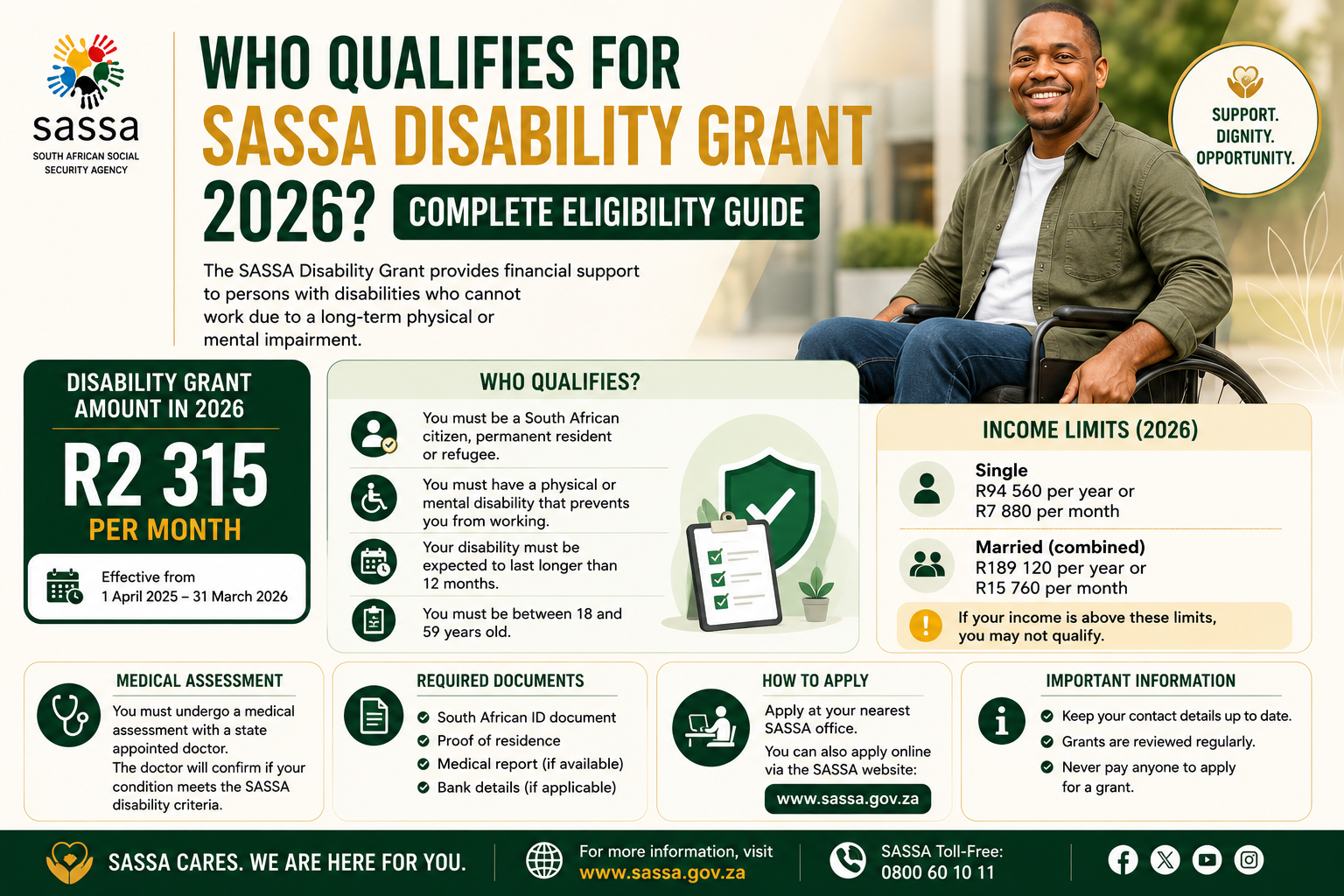
Find out who qualifies for the SASSA Disability Grant in 2026. Learn the eligibility rules, medical assessment, income limits, required documents, and application process.
Understanding SASSA Disability Grant
The South African Social Security Agency (SASSA) Disability Grant is a vital social assistance program designed to provide monthly financial support to adults who are unable to work due to physical or mental disabilities. This government grant helps thousands of South Africans meet their basic living needs, including food, healthcare, housing, and other essential expenses.
If you’re living with a disability and struggling financially, understanding whether you qualify for the SASSA Disability Grant is the first step toward accessing this crucial assistance. This comprehensive guide explains all the eligibility requirements, what documentation you’ll need, and how to apply.
SASSA Disability Grant Amount for 2026
Current Monthly Payment
Amount: R2,400 per month
The SASSA Disability Grant increased to R2,400 per month effective April 2026. This represents an increase of R85 from the previous amount of R2,315 per month.
However, it’s important to note that not all recipients receive the full amount. The grant amount is reduced if you have other sources of income that fall within the means test limits. If you earn income from part-time work, a pension, or other sources, your disability grant may be adjusted accordingly.
Additional Support Available
If you’re already receiving the Disability Grant and are physically or mentally unable to care for yourself, you may also qualify for Grant-in-Aid. This additional support of R580 per month is specifically for individuals who need full-time care from someone else. The combined payout would be R2,980 per month, helping you pay a caregiver for daily assistance.
Who Qualifies: Basic Eligibility Requirements
To qualify for the SASSA Disability Grant, you must meet several fundamental requirements. Missing even one of these criteria will result in your application being declined.
Age Requirement
You must be between 18 and 59 years old to qualify for the Disability Grant. This is a strict requirement that applies to all applicants.
- At Age 60: Once you reach 60 years old, you are no longer eligible for the Disability Grant. However, you automatically become eligible for the Old Age (Older Persons) Grant, which pays the same amount of R2,400 per month. The transition should happen smoothly, but it’s worth visiting your SASSA office a few months before your 60th birthday to confirm the switchover is in order.
South African Citizenship or Residency
You must be a South African citizen, a permanent resident eligible for SASSA, or a refugee eligible for SASSA, and you must be living in South Africa.
Acceptable residency status includes:
- South African citizens with a valid ID
- Permanent residents with permanent residency documentation
- Recognized refugees with valid refugee documentation
- Certain special permit holders
Living in South Africa
You must be living in South Africa with no stay in a state institution. This means you cannot receive the Disability Grant if you are living in a government-funded institution where the state provides you with full-time care, meals, and accommodation.
However, short-term hospital stays won’t affect your grant. If you’re living at home and going for treatment sessions, check-ups, or even extended day therapy, you remain eligible. The key distinction SASSA makes is between “the state fully caring for you 24/7” and “you managing your own life with periodic medical support.”
No Other Main SASSA Grant
You can only receive one main SASSA grant for yourself at a time. This means:
- You cannot receive both the Disability Grant and the Old Age Grant simultaneously
- You cannot receive both the Disability Grant and another main grant
- The only exception is Grant-in-Aid, which can be paid on top of your Disability Grant if you need full-time care
Medical Assessment: The Critical Requirement
One of the most important requirements for the SASSA Disability Grant is a medical assessment confirming your disability. This is not optional – it’s mandatory for all applicants.
What Medical Assessment Confirms
A medical assessment is compulsory for the SASSA Disability Grant. The applicant must be examined by a state-appointed doctor who completes an official medical report confirming the disability.
The medical assessment must document:
- Your specific disability or medical condition
- How the disability affects your ability to work
- The duration of the disability (whether it’s temporary or permanent)
- Any functional limitations you experience
- Whether you require ongoing medical treatment
Medical Certificate Requirements
The medical certificate submitted with your application must meet specific requirements:
- Not Older Than 3 Months: Your medical certificate cannot be older than 3 months at the date of application. This ensures the assessment reflects your current medical status.
- State-Appointed Doctor: Private medical reports are not accepted unless approved by SASSA. You must be examined by a state-appointed doctor, not a private physician.
- Official Format: The doctor completes an official medical report using SASSA’s prescribed format.
Temporary vs. Permanent Disability Grant
Based on the medical assessment, you can qualify for either:
Temporary Disability Grant
- Granted when the disability is expected to last between 6 months and 12 months
- Requires periodic review to confirm continued eligibility
- May need to reapply when the temporary period ends
Permanent Disability Grant
- Awarded when the disability is expected to last longer than 12 months with no reasonable prospect of returning to work
- Does not mean the grant is granted forever without question
- SASSA still calls you in for periodic reviews to confirm you meet the criteria
Disability Duration: The 6-Month Rule
A medical assessment for the Disability Grant is needed to prove long-term disability verification and confirm the disability lasting more than 6 months as part of the full SASSA Disability Grant requirements.
Your disability must be expected to last for a minimum of 6 months. This means:
- Short-term illnesses or temporary disabilities that are expected to resolve quickly won’t qualify
- The medical report must clearly state that the disability will last at least 6 months
- For permanent disabilities, the medical report should state there’s no reasonable prospect of returning to work
Means Test: Income and Asset Requirements
All applicants must pass a means test, which examines your income and assets to determine whether you genuinely need financial assistance.
Income Limits
Unlike some other SASSA grants, the Disability Grant checks your income and operates on a sliding scale. This means:
- If you have zero private income, you receive the full R2,400 per month
- If you earn income from part-time work, a pension, or other sources, your grant is reduced accordingly
- The amount of reduction depends on how much income you earn
Important: The income limits are generous enough to allow some earnings. If you earn a moderate income but still fall within the means test limits, you’ll receive a reduced grant rather than being declined completely.
Asset Assessment
Your total assets are also considered, excluding your primary home. Assets assessed include:
- Savings and bank accounts
- Vehicles and property (other than primary residence)
- Investments and stocks
- Insurance policies with cash value
- Business interests
If your assets exceed the approved limit, your application may be declined or your grant amount reduced.
Income Verification
SASSA verifies your income information through multiple government databases:
- SARS (South African Revenue Service): Checks for employment income and tax records
- Department of Employment and Labour: Checks UIF registration and payments
- Banks: Reviews your bank statements for income deposits
- Department of Home Affairs: Confirms citizenship and identity
This verification process can take up to 90 days during initial application.
Ineligibility Factors: Who Does NOT Qualify
Understanding what makes someone ineligible is just as important as understanding eligibility requirements.
State Institution Residents
You are ineligible if you are a resident of a state-funded institution where the government provides full-time care, meals, and accommodation. However, living independently while receiving treatment or therapy sessions does not disqualify you.
Existing Main Grant Recipients
If you’re already receiving another main SASSA grant, you cannot simultaneously receive the Disability Grant. You must choose one main grant.
Refusal of Medical Assessment
If you refuse to undergo the required medical assessment, your application will be declined. The assessment is non-negotiable and mandatory.
Income or Assets Exceed Limits
If your income or assets are too high, you will not qualify. SASSA may request additional documentation to verify your financial situation.
Documents Required for Application
Prepare the following documents before visiting SASSA:
Identification
- South African ID: Your original identity document
- No ID Yet: If you don’t have an ID, you’ll need a sworn affidavit plus a statement from a trusted person, while you apply for an ID at Home Affairs
Medical Documentation
- Medical Report: Recent medical or assessment report from a state-appointed doctor (not older than 3 months)
- Medical Certificate: Official SASSA medical assessment form completed by the doctor
Income Documentation
- Payslips: Current payslips if employed
- IRP5: Annual income tax certificate
- UIF Records: Unemployment Insurance Fund documentation if previously employed
- Discharge Certificate: From previous employer if unemployed
- Affidavit: Sworn statement if unemployed (available at police stations)
- Pension Proof: If receiving a private pension
Banking and Asset Documentation
- Bank Statements: Three consecutive months of bank statements
- Account Details: Your current bank account information for payment
- Asset Proof: Documentation of any assets you own
Citizenship and Residency
- Proof of Residency: Utility bill, lease agreement, or municipal account (not older than 3 months)
- Refugee Status: Valid refugee documentation (if applicable)
Family Status
- Marriage Certificate: If married
- Divorce Decree: If divorced
- Death Certificate: If widowed
How to Apply for SASSA Disability Grant
Step 1: Gather Documents
Compile all required documents listed above. Ensure all are original, valid, and current. Having everything ready streamlines the application process.
Step 2: Locate Your Nearest SASSA Office
Find the SASSA office closest to your home. Application forms are not available online; you must apply in person at a SASSA office.
Step 3: Visit SASSA Office
Visit your nearest SASSA office during operating hours. You cannot apply online or by mail for the Disability Grant.
If You Cannot Travel If you’re too old or sick to travel, a family member can apply on your behalf with:
- A letter of authority from you
- A doctor’s note confirming your inability to travel
- Your family member’s ID
Step 4: Complete Application Form
Request the Disability Grant application form at the SASSA office. A SASSA official will help you complete the form accurately with all required information.
Step 5: Submit Documents
Hand in your completed form along with all supporting documents to the SASSA official.
Step 6: Receive Application Receipt
You’ll receive an acknowledgment receipt showing the date of your application. Keep this receipt safe as it serves as proof that you applied.
Step 7: Wait for Assessment
SASSA processes applications over a period of time. During this period:
- Your documents are verified
- Your income is cross-checked with SARS and banks
- Your medical report is reviewed
- Your eligibility is assessed
Step 8: Receive Decision
SASSA will notify you of the decision. If approved, you’ll receive information about your payment date and method. If declined, you’ll receive a written explanation of the reasons.
Application Processing and Timeline
Processing Duration
Processing typically takes up to 90 days from submission. During this period, SASSA conducts thorough verification of your documents and circumstances.
Backpay Benefits
If your application is approved, your payments are backdated to the date you applied. This means you receive payment for the entire period from your application date to approval date, not just from the approval date forward.
For example, if you applied in January and were approved in April, you would receive backpay for January, February, and March in addition to your April payment.
What Happens if Your Disability Improves or Worsens?
Your circumstances may change after you start receiving the grant. It’s important to understand what happens in these situations.
If Disability Improves
If your disability improves and you can return to work, you may no longer be eligible for the grant. You must inform SASSA of the improvement. Continuing to receive the grant when you no longer qualify could result in overpayment claims.
If Disability Worsens
If your disability worsens, you may become eligible for additional support such as Grant-in-Aid. Contact SASSA to discuss your changed circumstances and potential additional assistance.
Periodic Reviews
SASSA conducts periodic reviews of all Disability Grant recipients to confirm continued eligibility. Temporary grants are always reviewed, while permanent grants may also be reassessed. You must attend reviews when called upon. Failure to attend reviews may lead to suspension of the grant.
Appeals and Reconsideration
If Your Application Is Declined
If your application is rejected, you have the right to appeal. The appeal process works as follows:
- Appeal Period: You have 90 days from receiving the decision to lodge an appeal
- Appeal Method: Submit your appeal through your nearest SASSA office
- Appeal Review: Your application will be reconsidered by SASSA
- Appeal Duration: The appeals process takes up to 90 days
- Final Decision: SASSA will provide a final written decision
Reapplication After Rejection
If your initial application was declined, you can reapply after correcting the reasons for rejection. If you gathered a more recent medical assessment or improved your financial documentation, a new application may be successful.
Conclusion
The SASSA Disability Grant is an important social safety net for South Africans living with disabilities who are unable to work. Understanding the eligibility requirements is crucial for anyone considering applying.
To qualify, you must be between 18 and 59 years old, be a South African citizen or recognized resident, have a confirmed disability expected to last at least 6 months, pass a means test, and provide a medical assessment from a state-appointed doctor.
If you believe you meet these criteria, don’t hesitate to visit your nearest SASSA office and begin the application process. The R2,400 monthly payment (from April 2026), or reduced amount if you have income, can provide crucial financial support for your daily living needs.
Remember to gather all required documents before visiting SASSA, have a recent medical assessment, and be prepared for the application and verification process. With patience and proper documentation, you can access the financial assistance you’re entitled to through the SASSA Disability Grant program.
For the most current information and guidance specific to your circumstances, always consult with SASSA officials at your local office. They’re there to help you navigate the application process and answer questions about your eligibility.
Frequently Asked Questions
Can I Work While Receiving the Disability Grant?
Yes, as long as your income stays within the means test limits. The grant is reduced based on your earnings, but you’re not prohibited from working.
What If I Don’t Have an ID?
You can apply using a sworn affidavit plus a statement from a trusted person while you apply for an ID at Home Affairs. However, apply for the ID immediately, as it’s required for grant processing.
Can Refugees Apply for the Disability Grant?
Yes, recognized refugees with valid documentation may apply for the Disability Grant if they meet all other eligibility criteria.
What Happens When I Turn 60?
When you turn 60, you automatically become eligible for the Old Age Grant, which pays the same amount (R2,400 from April 2026). Visit your SASSA office a few months before your 60th birthday to ensure a smooth transition.
Can I Receive Multiple Grants?
No, you can only receive one main grant at a time. The exception is Grant-in-Aid, which can be paid on top of your Disability Grant.