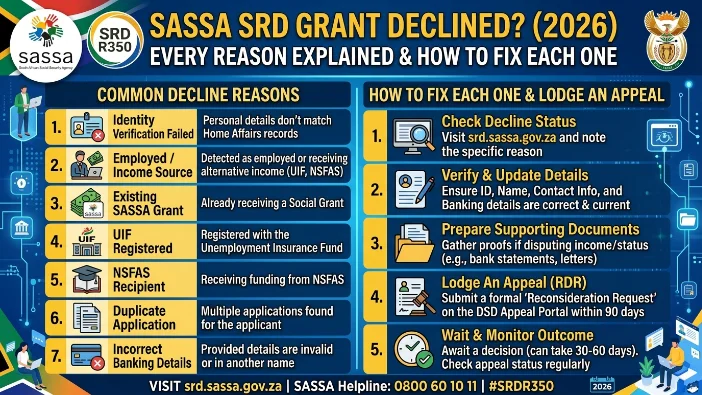
When your SASSA SRD R370 status shows Declined, the most important thing on your screen is not the word “Declined” — it is the reason shown directly below it.
That reason code is everything. Each decline has a different cause, a different fix, and different documents that will either win or lose your case on appeal. Picking the wrong action — or doing nothing at all — means losing your right to that month’s payment permanently once the 90-day window closes.
This guide covers every decline reason that currently appears on the SASSA SRD portal in 2026, explains what each one actually means, tells you honestly whether it is worth appealing or not, and gives you the exact documents to gather for each case.
Before You Do Anything: The Golden Rule of SRD Declines
A declined status is always month-specific. It is not a permanent ban. SASSA re-runs every eligibility check from scratch every single month using fresh data. A decline in May 2026 has zero effect on your June 2026 application.
This means two things:
- If the reason for your decline has changed or resolved on its own — for example, a once-off bank deposit that month — you may be approved automatically the very next month without doing anything
- You must still act within 90 days if you want to recover payment for the declined month itself
Do not reapply for the same month — it will not help and can create a duplicate application problem. Check the reason shown on the portal, then follow the specific steps for that reason below.
Important 2026 Court Update: Once-Off Transfers and the Twala Ruling
In January 2025, the Pretoria High Court ruled in the Twala case that the R624 income threshold is being applied unconstitutionally when it includes once-off gifts, emergency transfers from family members, and non-recurring deposits. The court ordered that these must be excluded from the means test.
As of June 2026, SASSA’s automated system has not yet been fully updated to implement this ruling. This means once-off family transfers can still trigger an income decline — but they can be successfully appealed using an affidavit and bank statement as evidence, because the court has confirmed this is your right.
If you were declined because of a once-off transfer, appeal immediately. Do not assume the system will correct itself.
Quick Reference: All SASSA SRD Decline Reasons (2026)
| Decline Reason Shown on Portal | Plain Meaning | Appeal Worth It? |
|---|---|---|
| Means Income Source Identified | Deposits above R624 detected | Yes, if once-off or gift |
| Alternative Income Source Identified | Same as above — different portal label | Yes, if once-off or gift |
| UIF Registered | Flagged on UIF database | Yes, if no longer employed |
| NSFAS Registered | Flagged as NSFAS beneficiary | Yes, if no longer a student |
| Existing SASSA Grant | Already receiving another grant | Only if recorded in error |
| Identity Verification Failed | ID details mismatch with Home Affairs | Yes — almost always an error |
| Government Payroll / GEPF Registered | Flagged on PERSAL or GEPF | Yes, if no longer employed |
| Age Outside Range | Under 18 or 60 and over | Only if age on system is wrong |
| Duplicate Application | More than one application linked to ID | Yes — contact SASSA immediately |
| Self-Exclusionary Response | You indicated income during application | Yes, if answer was incorrect |
| Banking Details Mismatch | Bank account not in your name | No appeal — update details |
| Cancelled | Application cancelled — not a decline | Reapply, do not appeal |
Every Decline Reason Explained — With Exact Fix for Each
Decline Reason 1: Means Income Source Identified / Alternative Income Source Identified
What the portal shows: “Means Income Source Identified” or “Alternative Income Source Identified” — these are two labels for the exact same decline. The fix is identical for both.
What it means: SASSA’s system detected deposits in your bank account during the month being assessed that total R624 or more. The automated system cannot tell the difference between a regular salary and a once-off gift — it sees the total deposits and flags them.
Deposits that can trigger this flag:
- Regular salary or wages
- UIF benefit payments
- NSFAS student allowances
- Money sent by family members (even for groceries or rent)
- Stokvel payouts
- Refunds from retailers or insurance
- E-wallet deposits from any source
- Temporary or informal jobs (washing cars, selling food, casual domestic work)
Is it a valid decline? Depends entirely on what caused the deposit:
- If you received a regular salary or income above R624 that month — the decline is correct. You do not qualify for that month. You may qualify again the following month if your income situation changes.
- If the deposit was a once-off gift, family transfer, stokvel payout, or refund — the decline may be a system error and is worth appealing, especially after the 2026 Twala High Court ruling.
Documents needed for a successful appeal:
For a once-off family transfer or gift:
- Three months of bank statements clearly showing the flagged deposit
- A sworn affidavit from you explaining the deposit (example wording: “The R800 deposit on 14 May 2026 was a once-off grocery contribution from my sister. I have no regular employment or income source.”)
- A sworn affidavit from the person who sent the money confirming it was a gift, not payment for any services
For a stokvel payout:
- A signed stokvel agreement document showing you are a member
- Your bank statement showing the payout
- An affidavit confirming the money is a one-time stokvel payout, not income
For a refund:
- Proof of the original purchase (receipt, invoice, or order confirmation)
- The refund notification from the retailer or service provider
Honest advice: Be specific in your affidavit. A vague explanation like “money from family” is weaker than a precise one that names the date, the amount, the person, and the reason. ITSAA reviews many appeals — a clear, honest, and specific explanation with supporting documents wins far more often than a general one.
Decline Reason 2: UIF Registered
What it means: The Department of Employment and Labour’s UIF database has a record linked to your ID number showing you as an active UIF contributor or recipient. SASSA’s automated system treats any UIF registration as evidence of an employment-related income source.
Why this happens to people who are not working: When you are employed in South Africa, your employer must register you with the UIF. When you leave a job — resign, get retrenched, or have your contract end — your employer is supposed to deregister you. Many employers do not do this. Your name then stays on the UIF database as if you are still employed, triggering an automatic decline every month even though you have no job and no income.
This is a common issue that affects thousands of SRD applicants whose previous employers did not complete the deregistration process after employment ended.
Is it worth appealing? Yes — if you are genuinely not employed and not receiving UIF payments, this is almost certainly a system error and should be appealed.
Step-by-step fix:
- Visit your nearest Department of Employment and Labour office in person
- Request a letter confirming your current UIF status — specifically ask for confirmation that you are not an active UIF beneficiary or contributor
- If your former employer failed to deregister you, the Labour Department can flag this and update the record
- You can also check your UIF status yourself at ufiling.labour.gov.za
- Submit your appeal at srd.sassa.gov.za/appeals with the Labour Department letter attached
- Include three months of bank statements showing no UIF deposits
Important: Getting the Labour Department letter takes priority over everything else. Without it, your appeal for a UIF decline is very difficult to win. That letter is your single strongest piece of evidence.
Decline Reason 3: NSFAS Registered
What it means: SASSA’s system found an active or recent NSFAS (National Student Financial Aid Scheme) record linked to your ID number. NSFAS funding is treated as a form of state financial assistance, and you cannot receive both NSFAS and the SRD grant at the same time.
Why this affects former students: NSFAS does not always remove your record from their database immediately after your funding ends. If you graduated, dropped out, or were defunded, but NSFAS has not updated your status, SASSA will still see you as an active beneficiary and decline your SRD application.
Is it worth appealing? Yes — if your NSFAS funding has ended and the record is outdated.
Step-by-step fix:
- Log into your NSFAS account at nsfas.org.za and check your current funding status
- If the portal shows your funding has ended or been cancelled, take a screenshot as evidence
- Contact NSFAS on 08000 67327 and request a written letter confirming your funding has ended and the date it was terminated
- Submit your ITSAA appeal at srd.sassa.gov.za/appeals with the NSFAS letter attached
Note: You cannot receive NSFAS and the SRD grant simultaneously — this is a hard rule. Only appeal if your funding has genuinely ended and the database simply has not caught up.
Decline Reason 4: Existing SASSA Grant
What it means: SASSA’s records show that a social grant is currently registered in your name. The SRD R370 grant cannot be received alongside any other personal SASSA grant — Disability Grant, Older Persons Grant, Care Dependency Grant, War Veterans Grant, or Grant-in-Aid.
The caregiver exception — a common misunderstanding: Being a caregiver for a child who receives a Child Support Grant does NOT disqualify you from the SRD grant. The Child Support Grant is registered in the child’s name, not yours. If you only receive Child Support Grant payments as a caregiver on behalf of a child, you are still eligible to apply for the SRD R370 in your own name.
Is it worth appealing?
- If you are a caregiver (not the registered beneficiary): Yes — appeal with documents showing the grant is registered in the child’s name, not yours
- If a grant in your name was cancelled but SASSA’s system has not reflected this: Yes — appeal with written confirmation from SASSA of the cancellation date
- If you are genuinely receiving another SASSA grant in your own name: No — the decline is correct
Documents for the appeal:
- Copy of the Child Support Grant registration showing the child’s name as the beneficiary (for caregiver cases)
- Written confirmation from SASSA that your personal grant was cancelled, including the cancellation date
Decline Reason 5: Identity Verification Failed
What it means: SASSA’s automated check against Department of Home Affairs (DHA) records could not match the details on your SRD application — name, surname, ID number, date of birth, or citizenship status — to what Home Affairs has on file.
From September 2025, this decline reason also covers incomplete eKYC (biometric) verification. If you have not completed your facial selfie verification or your biometric scan could not be matched, your application is declined under this same reason code.
Why it happens:
- A typo in your name or surname on the SRD application
- Your name after marriage or divorce differs from your Home Affairs record
- Middle names are in a different order between your application and your ID
- Home Affairs has an old or incorrect record that needs updating
- You have not yet completed the eKYC selfie verification
Is it worth appealing? Yes — this decline is almost always a data error, not a genuine eligibility problem.
Step-by-step fix:
If it is a typo or name mismatch:
- Contact SASSA on 0800 60 10 11 to correct the details on your SRD application
- In some cases you must visit a SASSA office in person with your original Smart ID card or green ID book
- If the error is in your Home Affairs record itself (not your application), visit your nearest Home Affairs office to have it corrected first
- Once corrected, submit your ITSAA appeal with a copy of your ID as supporting evidence
If your name changed due to marriage or divorce:
- Gather your marriage certificate or divorce decree as proof
- Visit SASSA or submit your appeal including the document explaining the name change
If it is an eKYC biometric issue:
- Check for an SMS from SASSA containing a verification link
- Complete the selfie verification within 72 hours of receiving the link
- If the link has expired, email grantenquiries@sassa.gov.za to request a new one
- If you do not have a smartphone, visit your nearest SASSA office for in-person biometric capture
Decline Reason 6: Government Payroll / GEPF Registered
What it means: SASSA checked the PERSAL system (the South African government’s central payroll system) and found a record linked to your ID number as an active or recent government employee. PERSAL covers all national and provincial government departments, municipalities, state-owned enterprises, and public entities. If PERSAL shows you as employed, your SRD application is automatically declined.
A separate flag — GEPF Registered — means your ID was found in the Government Employees Pension Fund database. This can affect former government employees whose GEPF records were not updated after retirement, resignation, or retrenchment.
Why it catches former employees: When a government employee leaves their position, the HR department of the relevant institution is supposed to update PERSAL and GEPF. If they fail to do this promptly, your record stays active and continues triggering SRD declines even though you no longer receive a government salary.
Is it worth appealing? Yes — if you no longer work for the government, this is a system record error and is fully appealable.
Step-by-step fix:
- Contact the HR department of your former government employer and request:
- A letter of service termination confirming your last official day of employment
- Written confirmation that your PERSAL record has been updated to reflect your departure
- Request a statement from GEPF if applicable, confirming you are no longer an active contributor
- Submit your ITSAA appeal at srd.sassa.gov.za/appeals with both letters attached
- State the termination date clearly in your appeal explanation and mention that the PERSAL or GEPF record may not yet reflect your departure
If you are currently a government employee: The decline is correct. You cannot receive the SRD R370 grant while employed by the government.
Decline Reason 7: Age Outside Range
What it means: The SASSA SRD R370 grant is only available to South African citizens, permanent residents, refugees, and asylum seekers who are between the ages of 18 and 59 (i.e., you must be 18 or older but have not yet turned 60). If your Home Affairs date of birth record places you outside this range, your application is declined automatically.
- Under 18: You do not qualify for SRD — your guardian may apply for a Child Support Grant on your behalf instead
- 60 and older: You do not qualify for SRD — you may be eligible for the Older Persons Grant (Old Age Pension) which pays R2,400 per month as of April 2026. Visit your nearest SASSA office to apply
Is it worth appealing? Only if your date of birth is recorded incorrectly in Home Affairs or on your SASSA application. If your correct date of birth places you within the 18–59 range, appeal with your original ID document as proof.
Decline Reason 8: Duplicate Application
What it means: More than one SRD application is linked to your South African ID number. This can happen in two situations:
- You applied more than once — for example, you submitted a fresh application while an existing one was still active
- Identity fraud — someone else used your ID number to apply for the SRD grant without your knowledge or consent
Is it worth appealing? Yes — contact SASSA immediately regardless of which situation applies.
Step-by-step fix:
For an accidental duplicate (you applied twice):
- Call SASSA on 0800 60 10 11 and ask them to identify which application is the valid one
- Request that the duplicate be removed from the system
- Submit your appeal once the duplicate is resolved
For identity fraud (someone used your ID):
- Report this to SASSA immediately on 0800 60 10 11 — ask them to freeze your SRD profile
- Report the fraud to the South African Fraud Prevention Service (SAFPS) at 0860 101 248
- Open a case at your nearest police station and obtain a case number
- Submit your ITSAA appeal with the police case number and SAFPS report as supporting evidence
Identity fraud on SASSA applications is a serious and growing problem in 2026. If you did not apply for the SRD grant but your ID shows an application, treat this as fraud immediately.
Decline Reason 9: Self-Exclusionary Response
What it means: When you completed your SRD application or annual reconfirmation, you answered one of the screening questions in a way that indicated you do not qualify. For example, if you answered “Yes” to “Are you currently employed?” or “Do you receive any other government grant?”, the system automatically declines your application based on your own answer.
This is sometimes done accidentally — especially by applicants who misread a question, selected the wrong option, or had someone fill in the form on their behalf who answered incorrectly.
Is it worth appealing? Yes — if the answer you gave was a mistake and does not reflect your actual circumstances.
Step-by-step fix:
- Go to srd.sassa.gov.za and log in with your ID number and registered phone number
- Look for the option to update or reconfirm your screening responses
- If the portal allows you to correct the answer, do so immediately
- Submit your ITSAA appeal explaining that the original answer was submitted in error, and describe your actual circumstances clearly
- Include a sworn affidavit confirming your correct employment and income situation
Decline Reason 10: Banking Details Mismatch
What it means: The bank account on your SRD application does not match your ID details. SASSA requires that your bank account is registered in your own name — the same name and ID number that appear on your SRD application. An account that belongs to a spouse, parent, sibling, or anyone else cannot be used.
Is it worth appealing? Not for the declined month — the decline is correct if you used someone else’s account. However, you should update your banking details on the SRD portal immediately so that future months are paid correctly.
Step-by-step fix:
- Log into srd.sassa.gov.za and go to the banking details section
- Update your payment details to a bank account registered in your own name
- If you do not have a bank account, you can open a free Capitec Smart Save account or a TymeBank account at Pick n Pay or Boxer without visiting a branch
- Alternatively, set your payment method to cash collection at a supported retailer (Shoprite, Checkers, Pick n Pay, Boxer, Spar, Usave) using your ID and registered phone number
Cancelled — This Is Not the Same as Declined
What it means: “Cancelled” is not a decline reason — it is a separate status that appears when your SRD application has been closed or deactivated. This can happen because:
- You did not reconfirm your application during the annual reconfirmation period
- You cancelled the application yourself
- SASSA cancelled it after a fraud detection flag
- Your application expired after a period of inactivity
What to do: You cannot appeal a cancelled application — there is nothing to appeal. You need to submit a new SRD application (reapplication) at srd.sassa.gov.za. A reapplication triggers a fresh full set of verification checks and typically takes 2 to 6 weeks to process.
Step-by-Step: How to Appeal a Declined SRD Application
Use these steps for every declined month. Each month must be appealed separately.
Step 1 — Note your exact decline reason Log into srd.sassa.gov.za using your 13-digit ID number and registered phone number. Find the declined month and write down the exact reason code shown. Your appeal explanation must match this reason directly.
Step 2 — Gather your documents before you start Use the document list for your specific decline reason from the sections above. Incomplete or blurry documents are the single most common reason appeals fail. Take clear photos or scans in good lighting.
Step 3 — Go to the appeals portal Open srd.sassa.gov.za/appeals in any browser. Enter your 13-digit ID number and registered phone number.
Step 4 — Verify your identity Click “Send PIN” and enter the OTP sent to your registered number.
Step 5 — Select the correct declined month The portal lists each month’s status separately. Select only the specific month you are appealing. If multiple months were declined, you will need to submit separate appeals for each one.
Step 6 — Choose the appeal reason Select the reason that matches the decline reason shown on your status page. Do not guess or select a general reason — match the exact wording.
Step 7 — Write your explanation Be short, specific, and honest. State what happened in plain language. For example: “I was declined for Alternative Income Source Identified for May 2026. The R900 in my account that month was a once-off emergency transfer from my brother on 8 May 2026. I am unemployed and have no regular income. I have attached my bank statement and a sworn affidavit from my brother confirming this.”
Step 8 — Upload your documents Upload clear, readable photos or scans. Every document must be clearly legible. Blurry uploads are rejected without review.
Step 9 — Submit and save your reference number After submitting, save your reference number immediately. Screenshot it or write it down. You will need it to follow up.
Do not resubmit — one appeal per declined month is enough. Duplicate appeals cause delays.
Will You Get Back-Pay if Your Appeal Is Approved?
Yes. If ITSAA approves your appeal for a specific month, SASSA processes back-payment for that month. The payment goes into the bank account or collection method currently on your profile. You do not need to take any additional steps — the system updates automatically once ITSAA’s decision is logged.
Back-pay is paid month by month. If three months were declined and all three appeals are approved, you receive three separate back-payments.
What Happens if Both Reconsideration and ITSAA Appeal Are Declined?
If ITSAA declines your appeal, that decision is final for that specific month. Your remaining options:
- Apply again next month — each new month is a fresh assessment. If the reason for your decline was temporary (a one-off bank deposit, a corrected UIF record), you may be approved without any appeal next month
- Judicial review at the High Court — within 180 days of the ITSAA decision, if there is clear evidence the decision was unlawful. Contact Legal Aid South Africa (legalaid.org.za) for free legal advice
- Contact Black Sash — a trusted non-profit offering free SASSA grant advice and advocacy at 072 663 3739
Frequently Asked Questions
What does SASSA SRD declined mean?
Declined means your SRD R370 application did not pass one or more of SASSA’s automated eligibility checks for that specific month. It is not a permanent ban — each month is assessed independently and a decline in one month has no effect on the next month.
Why is my SASSA SRD declined every month?
If you are declined every single month, the cause is likely a persistent issue in one of the government databases SASSA checks. Common repeat causes include: a UIF record that was never deregistered, a PERSAL or GEPF record from a former government job, an outdated NSFAS record, a joint bank account, or recurring deposits above R624. Identify the specific reason code shown each month — if it is always the same reason, fix the underlying database issue at the source (the Labour Department for UIF, your former employer’s HR for PERSAL, NSFAS directly for student records).
Can I appeal a SASSA SRD decline after 90 days?
Generally no — the 90-day window is fixed and there is no standard extension. If you miss the deadline, you permanently lose the right to appeal that specific month’s payment online. In very limited circumstances, ITSAA may accept a late appeal with an Application for Condonation (a written request explaining the reason for the delay) — but this is not guaranteed. Always aim to appeal well within the 90-day window.
Does a declined SRD affect next month’s application?
No. Each month’s SRD application is assessed completely independently. Being declined in one month does not affect or block your eligibility for any other month. SASSA runs fresh checks every month using new data from all five databases.
Can I appeal if I was declined because of a family member’s transfer?
Yes — and the 2026 Pretoria High Court Twala ruling specifically supports this. The court found that once-off gifts and non-recurring transfers from family members should not count toward the income threshold. Submit a sworn affidavit explaining the deposit clearly, attach your bank statement, and get a supporting affidavit from the person who sent the money. This type of appeal has a strong success rate when properly documented.